




Why Moisture Wicking Shirts Fail: 7 Fixes That Work

Table of Contents
- Why Moisture Wicking Shirts Fail: The Core Reasons
- How to Stop Sweating Through Your Shirt (What Actually Works)
- Moisture-Wicking vs Sweat-Proof: What's the Real Difference?
- Why Synthetic Fabrics Hold Sweat Odour (And How to Fix It)
- Fabric Degradation: When Wicking Shirts Stop Working
- Fit and Layering Mistakes That Cause Clamminess
- Frequently Asked Questions
Last Updated: September 18, 2026
Why Moisture Wicking Shirts Fail: The Core Reasons
Moisture wicking shirts fail when the fabric's transport system breaks down: sweat moves along the fibres to the surface, but if it cannot evaporate faster than you produce it, the garment saturates and clings. The shirt is not defective. The conditions around it are wrong.
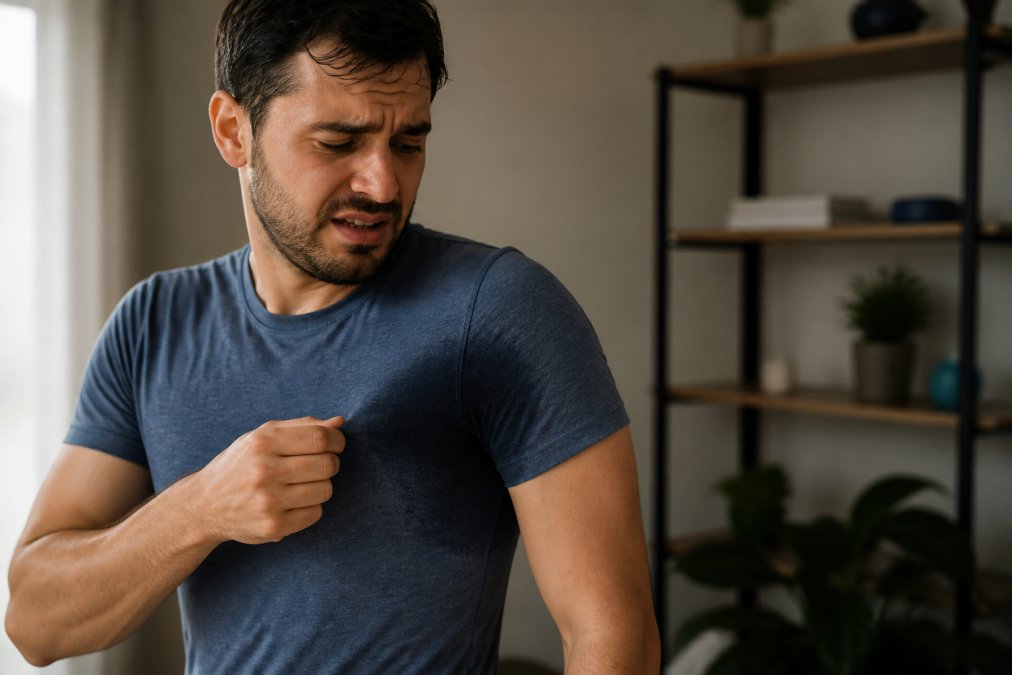
Four failures account for most complaints:
- Saturation: the fabric holds more sweat than it can release
- Odour lock: synthetic fibres trap oils and bacteria
- Degradation: the wicking finish washes out over time
- Fit and layering: a tight outer layer traps the moisture you just moved away
How to Stop Sweating Through Your Shirt (What Actually Works)
You cannot stop sweating, but you can stop it showing. The fix is a two-part approach: reduce what reaches your outer layer, and choose a garment built to hide what does.
Here is what works in practice:
- Start with the right base layer. A close-fitting shirt makes better skin-to-fabric contact, which speeds sweat transport.
- Match fabric weight to conditions. Lightweight knits for heat, heavier knits for layered wear.
- Avoid cotton as your first layer if you sweat heavily. Cotton is hydrophilic: it absorbs and holds water rather than releasing it.
- Wash correctly. Fabric softener coats fibres and blocks wicking. Skip it.
- Replace worn base layers. Wicking performance declines with repeated washing.
Moisture-Wicking vs Sweat-Proof: What's the Real Difference?
These are two different jobs, and confusing them is why so many people are disappointed.
| Feature | Moisture-Wicking | Sweat-Proof |
|---|---|---|
| Primary job | Move sweat off skin | Hide sweat from view |
| Works on | Light to moderate perspiration | Heavy perspiration |
| Visible under a dress shirt | Often shows through | Designed to stay hidden |
| Typical construction | Single technical knit | Multi-layer or treated fabric |
| Best for | Exercise, warm weather | Work, formal wear, hyperhidrosis |
Why Synthetic Fabrics Hold Sweat Odour (And How to Fix It)
Polyester and polypropylene are oleophilic: they attract and hold body oils. Bacteria feed on those oils, and the smell stays locked in the fibre even after a wash. That is the short version. The longer version explains why a shirt that smelled fine for six months suddenly reeks, and why a normal wash cycle often makes it worse.
The mechanism, step by step
- You sweat. Sweat itself is mostly water and is largely odourless when fresh.
- Your skin produces sebum, body oil, which the hydrophobic synthetic fibre grabs and holds.
- Bacteria, particularly species that thrive in warm damp fabric, colonise the oil film inside the fibre, not just on the surface.
- Their metabolic by-products are the smell. Because the bacteria sit inside the fibre structure, a surface rinse does not reach them.
- Standard detergent is formulated to lift dirt and oils from the surface. It is not formulated to penetrate the interior of a polyester filament.
This is why odour returns within minutes of wearing a "clean" shirt. The bacteria were never removed; they were only temporarily suppressed.
Why cotton behaves differently
Cotton is hydrophilic. It absorbs water readily and releases oils more easily during washing, so the oil film that feeds bacteria is disrupted by a normal cycle. The trade-off is real: cotton smells better but wicks worse. Synthetics wick better but hold odour. There is no fibre that does both perfectly, which is why base layer choice is a compromise, not a solution.
What actually removes the odour
- Wash after every wear. Bacteria need time, not just sweat. A shirt left in a gym bag overnight is already colonised.
- Use a sports-specific detergent with enzymes that break down oils and proteins. Standard detergents often leave a residue that feeds bacteria.
- Skip fabric softener entirely. It coats fibres in a waxy film that seals odour in and blocks wicking at the same time.
- Avoid overloading the machine. A packed drum means less mechanical agitation and less rinse water reaching each garment.
- Air-dry in direct sunlight where possible. UV helps break down residual bacteria.
- Soak in a diluted white vinegar solution before washing for stubborn build-up. The acid helps break the oil film.
- Never leave a damp shirt in a bag or hamper. Damp, dark, warm conditions are ideal for bacterial growth.
When to stop trying
If odour keeps returning after a proper wash cycle with a sports detergent, the fibres have likely absorbed oils permanently. At that point the shirt is a bacterial reservoir and no amount of soaking will fix it. Replace it. A common pattern is that a shirt used three or four times a week needs replacing within twelve to eighteen months, not because the fabric has worn out visually but because the odour load has become permanent.
The prevention angle most guides miss
Odour is not a washing problem. It is a rotation problem. If you own two wicking shirts and wear them five days a week, you are asking each shirt to hold more oil than a single wash cycle can remove. Owning four or five and rotating them gives each garment time to dry fully and reduces the oil load per wash.
Fabric Degradation: When Wicking Shirts Stop Working
Wicking performance is not permanent. Most shirts rely on a chemical wicking finish, and that finish washes out. This is the failure mode almost no guide mentions. A shirt that wicked beautifully in month one can behave like a damp rag by month twelve, and there is no visible sign it has changed.
Chemical versus mechanical wicking
Chemical wicking applies a hydrophilic treatment to a hydrophobic fibre. The treatment is a surface finish, and it works well, until it does not. It degrades with washing, heat, detergent residue and fabric softener.
What destroys the finish
The order of damage, from worst to least:
- Fabric softener. It deposits a waxy film on the fibre surface that physically blocks the capillary channels. One or two washes with softener can measurably reduce wicking.
- High heat drying. Heat accelerates the breakdown of the chemical finish more than any other single factor. Tumble drying on high is the fastest way to kill a wicking shirt.
- Detergent residue. Powder detergents that do not fully dissolve leave a film that clogs the fibre surface.
- Repeated washing cycles. Even with correct care, a chemical finish has a finite lifespan.
- Sunscreen and body lotion. These leave oily residues that behave like fabric softener, blocking the capillary channels.
The environmental saturation limit
Here is the failure mode that has nothing to do with the shirt. Wicking works by moving sweat to the fabric surface so it can evaporate into the air. Evaporation depends on the air's capacity to accept more moisture. In high humidity, that capacity is already close to full.
How to extend the life of a wicking shirt
- Wash in cold water on a gentle cycle. Heat is the enemy of the chemical finish.
- Never use fabric softener. Not once. It is the single most damaging thing you can do.
- Skip the dryer, or use low heat only. Air-drying preserves the finish.
- Use a liquid detergent rather than powder, to avoid undissolved residue.
- Wash separately from heavy cotton items that shed lint, which can clog fibre surfaces.
- Avoid washing with towels. Towel lint is a common cause of reduced wicking.
The replacement decision
A shirt with a degraded chemical finish cannot be restored. No detergent or soak will rebuild a hydrophilic treatment that has washed away. If a shirt that used to dry in twenty minutes now stays damp for an hour, the finish is gone. Replace it, and replace it with a mechanically wicking fabric if you want the performance to last.
Fit and Layering Mistakes That Cause Clamminess
Clamminess comes from trapped moisture, and the usual culprit is the layer above your base.
Three mistakes drive most cases:
- Too tight an outer layer. A dress shirt cut close over a bulky base layer traps vapour.
- Too many layers. Each layer adds insulation and reduces breathability.
- Wrong base layer size. A loose base layer reduces skin-to-fabric contact and slows sweat transport.
Frequently Asked Questions
Do moisture-wicking shirts actually work for heavy sweating?
For light to moderate sweat, yes. For heavy sweating or hyperhidrosis, standard moisture-wicking shirts often reach saturation quickly and stop moving moisture away from your skin. The fabric can only transport so much liquid before it becomes overwhelmed. If you sweat heavily, look for garments with a sweat-proof layer or triple-layer underarm protection that physically blocks moisture from reaching your outer clothing. These are designed for higher volume and longer wear times than standard wicking fabrics.
Why do my moisture-wicking shirts still smell after washing?
Synthetic fabrics like polyester trap odour-causing bacteria deep inside their fibres because the fabric is hydrophobic, meaning it repels water but attracts oils and bacteria. Regular detergent washes away surface grime but doesn't always penetrate the fibre structure. Try washing with a sport-specific detergent or adding half a cup of white vinegar to the rinse cycle. Avoid fabric softener entirely, as it coats the fibres and locks in odour while also reducing the fabric's ability to wick moisture.
What is the difference between moisture-wicking and sweat-proof technology?
Moisture-wicking fabric moves sweat away from your skin to the surface of the garment where it evaporates. Sweat-proof technology goes further by preventing moisture from passing through to your outer clothing altogether. Brands like Sweat Proof Apparel use a triple-layer underarm construction that physically blocks sweat from showing through dress shirts, which is a different mechanism from wicking. Wicking manages moisture; sweat-proof containment stops it from reaching visible layers.
Can fabric softeners ruin the performance of moisture-wicking clothing?
Yes. Fabric softener leaves a waxy coating on synthetic fibres that clogs the capillary channels responsible for moving sweat. Once those channels are blocked, the fabric can't transport moisture to the surface for evaporation, so it feels clammy and heavy. If you've already used softener, wash the garment two or three times with a vinegar rinse to strip the residue. After that, skip softener entirely and tumble dry on low or hang dry to preserve wicking efficiency.
Sweat management is a system, not a single purchase. If your moisture wicking shirts keep failing, the problem is usually the combination of fabric, fit, and the layer above. Sweat Proof Apparel builds shirts with a fabric and Neat™ technology blend, triple-layer underarm protection, and a 95% premium cotton and 5% spandex construction that tumble dries without shrinking. Get started with Sweat Proof Apparel and stop planning your day around your sweat.