




Thompson Tee Alternative for Hyperhidrosis: 2026 Guide

Table of Contents
- Why People with Hyperhidrosis Look Beyond One Brand
- What Actually Makes a Sweat-Proof Undershirt Work
- How to Stop Underarm Sweat Marks Under Dress Shirts
- Sweat-Proof Undershirt Options Worth Trying
- Sweat-Proof Undershirt Care Instructions That Protect the Technology
- Skin Sensitivity, Hypoallergenic Testing and Long-Term Costs
- Frequently Asked Questions
Last Updated: September 21, 2026
Why People with Hyperhidrosis Look Beyond One Brand
Hyperhidrosis causes sweating far beyond what the body needs for temperature regulation. For people living with it, the search for a Thompson Tee alternative for hyperhidrosis usually starts the same way: a brand that worked for a while, then didn't.
Hyperhidrosis isn't a single problem with a single fix. It's a spectrum.
- Underarm-focused sweating responds well to a targeted underarm shield built into an undershirt.
- Full-torso sweating needs a moisture-wicking base layer across the whole back and chest.
- Anxiety-triggered sweating needs a solution that breaks the feedback loop, not just hides the evidence.
One brand may not cover all three equally well, which is why some people with excessive sweating compare options rather than committing to a single label.
What Actually Makes a Sweat-Proof Undershirt Work
A sweat-proof undershirt places a physical moisture barrier between your skin and your outer shirt, usually at the underarm. Wicking fabric alone won't stop a visible sweat mark, it moves moisture, it doesn't block it.
Moisture-Wicking vs Sweat-Proof Undershirts: The Real Difference
Moisture-wicking fabric pulls perspiration away from the skin and spreads it across a wider surface so it evaporates faster. It keeps you feeling drier and reduces odour, but under a light dress shirt, the moisture still reaches the outer layer. You'll often see a damp patch form anyway, just slightly later.
The practical difference:
| Feature | Moisture-Wicking | Sweat-Proof |
|---|---|---|
| Stops visible sweat marks | No | Yes, at the underarm |
| Keeps skin feeling dry | Yes | Partly |
| Best for | Light sweating, active wear | Hyperhidrosis, dress shirts |
| Fabric weight | Light | Slightly heavier |
| Cost per shirt | Lower | Higher |
Fabric Blends Compared: Bamboo, Micro-Modal, Cotton and Polyester
The fabric blend decides how the shirt feels, how it washes, how long the barrier lasts and how it behaves against reactive skin. Here's how the four common fibres perform in a sweat-proof context.
-
Bamboo cotton is soft, breathable and moisture-absorbent, but bamboo viscose loses tensile strength when wet, so a bamboo-rich undershirt can stretch at the underarm and pull the barrier panel out of alignment. It also pills faster than modal. Best for cool climates and light sweating; less suited to daily hyperhidrosis wear.
-
Micro-modal is a refined beechwood fibre with a finer yarn than cotton, so it feels smoother and holds colour better over repeated washes. Its real advantage is dimensional stability: modal resists shrinking and holds its shape under a fitted outer shirt, so the underarm panel stays where it was sewn. The trade-off is cost and a slightly slicker hand-feel.
-
Cotton is comfortable, hypoallergenic and easy to wash, but pure cotton holds moisture and dries slowly. It earns its place as the skin-side layer of a blend: it's the fibre least likely to irritate reactive skin and breathes well enough to stop heat building under the barrier. A cotton-rich blend with a little elastane gives softness without the sag.
-
Polyester wicks well and dries fast, but it's oleophilic, it attracts and holds body oils and odour-causing bacteria, and that smell can survive repeated washing. Against sensitive or antiperspirant-irritated skin it can also feel clammy, because it doesn't absorb moisture the way cellulose fibres do.
Why the Barrier Layer, Not the Fabric, Is the Deciding Factor
Two undershirts can use identical fabric blends and perform differently, because the barrier is a separate construction. Weigh barrier construction as heavily as fibre content, that's the part doing the work your hyperhidrosis needs.
How to Stop Underarm Sweat Marks Under Dress Shirts
Stopping underarm sweat marks under a dress shirt comes down to three layers: an antiperspirant applied correctly, a sweat-proof undershirt, and an outer shirt that isn't fighting you.
"Pit Stopper" Neat™ Crew Neck Undershirt →
Here's the sequence that works:
- Apply clinical strength antiperspirant at night, not in the morning. It needs several hours on dry skin to plug the sweat ducts effectively.
- Let it dry fully before dressing. Residual product transfers onto fabric and stains it over time.
- Wear a sweat-proof undershirt with a fitted cut so the underarm panel sits flush against the skin, not bunched.
- Choose a mid-weight dress shirt in a darker or patterned weave. Very light, tight poplin shows moisture fastest.
- Keep a spare undershirt in your bag or desk drawer for long days.
Sweat-Proof Undershirt Options Worth Trying
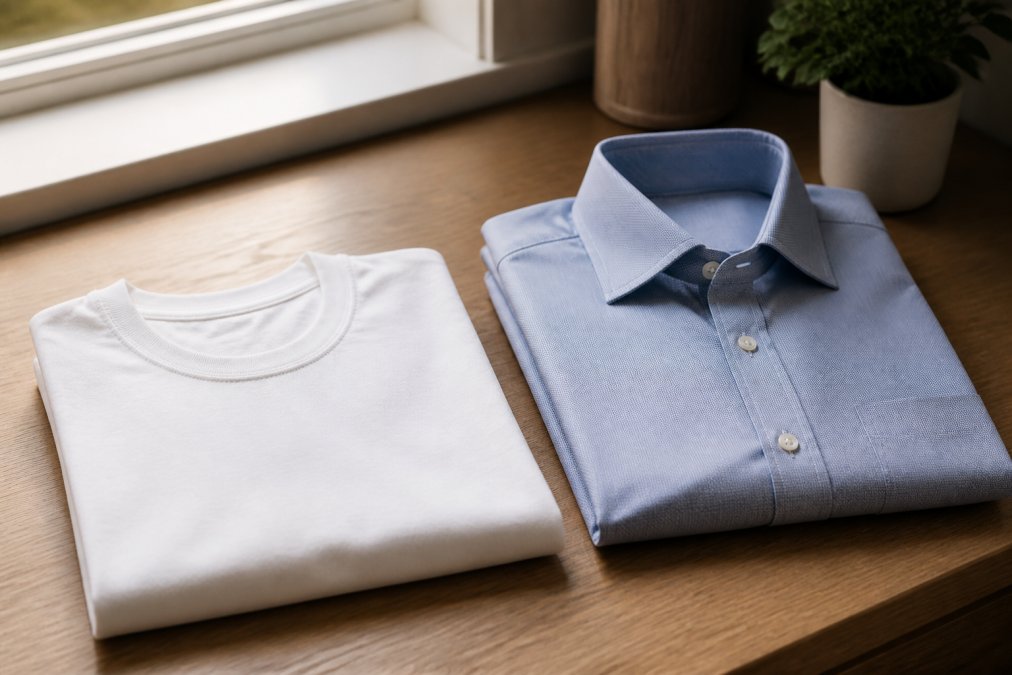
Crew Neck vs V-Neck: Which Cut Suits Your Wardrobe
Crew neck works under crew-neck tees, polos and casual shirts. V-neck works under open-collar dress shirts and anything with a visible neckline. If you wear both, buy both.
Fit and Sizing: Getting the Right Layer First Time
A sweat-proof undershirt only works if the underarm panel sits against the skin. Too loose and it shifts; too tight and it restricts movement and feels hot.
Sweat-Proof Undershirt Care Instructions That Protect the Technology
Sweat-proof undershirt care instructions matter more than most people realise: the barrier layer is the expensive part, and it fails first when washing goes wrong.
Follow these rules:
- Wash in cold or cool water. Heat degrades bonded barrier layers and shrinks cotton blends.
- Skip fabric softener entirely. It coats the fabric and reduces moisture management.
- Turn the shirt inside out before washing to protect the inner shield from friction.
- Tumble dry low, or line dry. Sweat Proof Apparel's Neat™ shirts are designed to tumble dry without shrinking, but low heat is still the safer setting.
- Never iron the underarm panel directly. Heat and pressure can damage the bond.
- Rotate at least three shirts so each one gets a rest between wears. This alone extends the life of the barrier significantly.
Skin Sensitivity, Hypoallergenic Testing and Long-Term Costs
Skin sensitivity is an issue some guides may not cover. Hyperhidrosis often comes with sensitive skin, especially if you use clinical strength antiperspirant. Aluminium-based antiperspirants form a plug in the sweat duct and can leave underarm skin drier, thinner and more irritation-prone over time. Layering a non-breathable synthetic barrier over that skin invites contact dermatitis, which is why fabric choice matters as much as sweat blocking.
Look for:
- Hypoallergenic fibres such as cotton and micro-modal, which are less likely to trigger irritation than coarse synthetics. Cellulose fibres absorb moisture into the fibre itself, so sweat doesn't sit on the skin surface the way it does with polyester.
- No harsh dyes or finishes near the underarm area. Reactive dyes and formaldehyde-based easy-care finishes are common irritants, and they're most concentrated in dark, saturated colours.
- Breathable construction so trapped heat doesn't cause a rash. A barrier blocks moisture, not air; if the surrounding fabric can't breathe, the underarm becomes a warm, damp microclimate.
- A smooth, flat seam or bonded edge at the underarm panel. Raised stitching under a fitted shirt creates friction points that worsen with movement.
The Cost-per-Wear Maths Most Guides Ignore
Long-term cost is where a cheap undershirt usually loses. Compare cost per wear over 12 months, not sticker price.
Frequently Asked Questions
What are the most effective alternatives to Thompson Tee for hyperhidrosis?
The most effective options use a multi-layer underarm shield rather than moisture-wicking fabric alone. Sweat Proof Apparel's Neat™ range, for example, builds an extra underarm shield into a 95% premium cotton and 5% spandex blend, so sweat is blocked from passing through to your outer shirt. Look for a fitted construction that tucks cleanly under dress shirts, plus a fabric that survives repeated washing without losing its sweat-blocking layer.
Do sweat-proof undershirts actually stop sweat marks?
They stop sweat reaching your outer shirt, which is the part people actually see. A sweat-proof undershirt works as a barrier layer: the underarm shield holds moisture inside the garment instead of letting it soak through your dress shirt or polo. Note that a white undershirt can look damp on its own even when completely dry, because white is transparent. That is why these shirts are designed to be worn under something, not as a standalone tee.
How do I follow sweat-proof undershirt care instructions without ruining the fabric?
Wash in cold water and tumble dry on low. Sweat Proof Apparel's Neat™ undershirts are built to tumble dry without shrinking, which removes the main reason people hand-wash technical garments. Skip fabric softener and high heat, since both coat and stress the fibres that do the moisture management. Turn the shirt inside out before washing to protect the underarm shield, and avoid ironing directly on that panel.
How many hours of protection should I expect from a sweat-proof undershirt?
Protection depends on your sweat rate, the outer shirt you wear, and the room you are in, so no single number applies to everyone. What matters more is the barrier design: a fitted undershirt with a dedicated underarm shield keeps sweat contained for a full working day under normal conditions, while a basic moisture-wicking tee will saturate and pass moisture through much sooner. Carry a spare in your bag for high-stakes days.
How do I choose the right size for a sweat-proof undershirt?
Measure your chest and follow the brand's size chart rather than guessing from your regular t-shirt size. The fit needs to be close to the body, because a loose sweat-proof undershirt shifts under the arm and lets sweat escape around the shield instead of through it. If you sit between two sizes, size down for a fitted undershirt layer and up if you plan to wear it as a standalone tee.