




Sweat Proof Undershirt vs Regular Undershirt

Table of Contents
- Sweat Proof Undershirt vs Regular Undershirt: The Core Differences
- How Sweat-Proof Barrier Technology Works
- What a Standard Cotton Undershirt Actually Does
- Moisture-Wicking vs Sweat-Proof Undershirts: Two Different Jobs
- Absorbency, Breathability and Comfort: How Each Type Performs All Day
- Preventing Yellow Armpit Stains: Why Fabric Choice Decides It
- Durability, Wash Care and Long-Term Odour Retention
- Finding the Best Sweat Proof Undershirt: What to Look For
- Frequently Asked Questions
Last Updated: September 15, 2026
Sweat Proof Undershirt vs Regular Undershirt: The Core Differences
A sweat proof undershirt uses a physical barrier layer that stops perspiration from reaching your outer clothing; a regular undershirt is a basic cotton layer that absorbs some moisture but lets the rest pass through to your dress shirt. That distinction, barrier versus blotter, decides how long protection lasts, whether yellow stains form, and how your shirt looks by 2pm.
This guide from Sweat Proof Apparel breaks down the two garment types side by side, from how barrier technology works to what it costs you over a year of wear.
How Sweat-Proof Barrier Technology Works
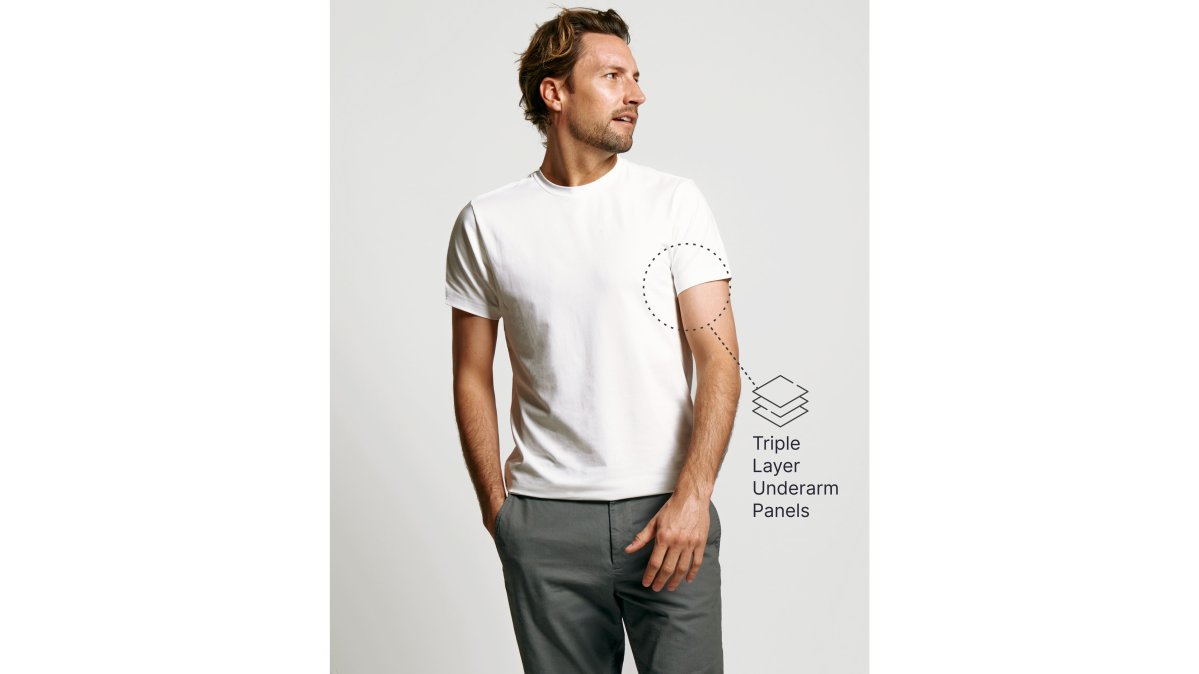
Sweat-proof undershirts use a multi-layer construction under the arms: a soft inner face against your skin, a hydrophobic membrane in the middle, and an outer face that stays dry to the touch. Perspiration passes through the inner layer, hits the barrier, and stops there, spreading sideways and evaporating through the fabric edges rather than soaking through to your shirt.
The result is sweat-through protection measured in hours of wear, not minutes. A triple-layer underarm shield, like the one in the "Pit Stopper" Neat™ Crew Neck Undershirt, keeps the barrier fixed where perspiration starts, while the rest of the shirt stays light and breathable.

What a Standard Cotton Undershirt Actually Does
A regular undershirt absorbs perspiration and holds it against your body. Cotton is hydrophilic, so a standard tee soaks up moisture well at first, but once it reaches saturation, the excess transfers directly into your outer shirt.
A regular undershirt is not a failed product; it does a different job, comfort, warmth, and a thin layer between skin and work shirt. It was never designed to block moisture transfer, so expect it to manage light perspiration briefly, then pass the problem upward.
Moisture-Wicking vs Sweat-Proof Undershirts: Two Different Jobs
Moisture-wicking vs sweat-proof undershirts is a comparison worth getting straight, because the terms get used interchangeably but are not the same thing. Moisture-wicking fabric moves perspiration away from your skin and spreads it across a wider surface area so it evaporates faster, it manages sweat, but still lets moisture travel through the garment.
Sweat-proof fabric blocks the transfer entirely at the underarm. Wicking is about evaporation rate; blocking is about interception. If your goal is staying comfortable during a commute, wicking is enough. If your goal is a dry dress shirt at a 9am client meeting, you need the barrier.
| Feature | Regular Cotton Undershirt | Moisture-Wicking Undershirt | Sweat-Proof Undershirt |
|---|---|---|---|
| Primary job | Absorb and hold | Move moisture to evaporate | Block transfer at the underarm |
| Fabric behaviour | Hydrophilic | Hydrophobic fibres | Hydrophobic barrier layer |
| Sweat-through protection | None once saturated | Partial | Hours of wear |
| Stain prevention | Poor | Moderate | Strong at the underarm |
| Best for | Cool days, light activity | Active wear, warm climates | Dress shirts, high-pressure settings |
Absorbency, Breathability and Comfort: How Each Type Performs All Day
Comfort in an undershirt is a moisture-management problem, not a thickness problem. A garment that blocks sweat but traps heat is a net loss, because the body responds to trapped heat by producing more perspiration, so breathability and barrier performance must be engineered together.
How breathability actually works in a barrier garment
Airflow through an undershirt happens two ways: through the fabric (vapour transmission) and around the garment edges (convective venting). A barrier panel blocks liquid transfer at the underarm, but water vapour still needs an exit route. Better designs pair a hydrophobic membrane with a knit outer face that lets vapour escape while resisting liquid strike-through, so the shirt feels dry to the touch outside.
A regular cotton tee behaves differently: it holds moisture against the skin. For the first hour it feels cool as evaporation happens at the fabric surface, but once the fibres approach saturation, evaporation slows, the fabric clings, and the cooling effect reverses into a clammy, heavy sensation, the 'fine at 9am, miserable at 2pm' pattern many wearers describe.
Heat regulation: why the underarm-only design matters
A full-torso barrier traps heat across the chest and back, two of the body's largest heat-exchange surfaces. Restricting the barrier to the underarm panel, as the "Pit Stopper" Neat™ Crew Neck Undershirt does, keeps the rest of the torso in a breathable knit so core heat can vent. This is the biggest comfort differentiator between a well-designed sweat-proof undershirt and a cheap one that laminates plastic across the whole front.
Climate-specific layering
Performance varies meaningfully by environment:
- High humidity (coastal summer, tropical wet season): ambient air is near saturation, so evaporative cooling is slow. Prioritise a thin, single-layer barrier and a lightweight outer shirt; avoid heavy cotton over the top.
- Dry heat (inland summer): evaporation is fast, so wicking layers do more of the work. A sweat-proof undershirt still earns its place under dress shirts, but you can afford a slightly heavier knit because vapour clears quickly.
- Cooler months with indoor heating: the risk shifts to odour and overheating indoors. A breathable barrier undershirt under a jumper handles the temperature swing better than a cotton tee, which saturates on the commute and stays damp at the desk.
- Air-conditioned offices: the barrier prevents the cold-and-damp feeling that comes from a saturated cotton tee meeting chilled air.
Skin sensitivity and hypoallergenic considerations
People who sweat heavily often have reactive skin, and the inner face sits against it for ten hours or more. Three checks before you buy:
- Inner-face material: a soft cotton or cotton-blend inner face is generally kinder than a bare synthetic membrane against the skin.
- Dye and finish: undyed or low-dye whites reduce irritation risk. If you have known sensitivities, patch-test on a short wear before committing to a full day.
- Seam placement: flatlock or bonded seams under the arm reduce friction, which matters when the underarm is already the warmest, dampest part of the body.
If you have a diagnosed skin condition or hyperhidrosis, check with your GP or dermatologist before relying on any garment as your primary strategy, an undershirt manages symptoms, it does not treat the condition (Excessive sweating (hyperhidrosis) - causes and treatments).
Fit is part of the comfort equation
A tapered fit keeps the barrier panel flat against the underarm; a loose shirt lets it shift, and a shifted barrier leaks. The "Pit Stopper" Neat™ V-Neck Undershirt uses a fitted construction so the shield stays put, for anyone dealing with excessive sweating or hyperhidrosis, that reliability is the whole point.
Preventing Yellow Armpit Stains: Why Fabric Choice Decides It
Durability, Wash Care and Long-Term Odour Retention
Why technical fabrics retain odour differently to cotton
A six-month maintenance routine
Signs it is time to replace, not rescue
Environmental note on synthetic barriers
Finding the Best Sweat Proof Undershirt: What to Look For
Here is what to check before you buy:
Frequently Asked Questions
Do sweat proof undershirts actually work?
Yes, when they use a physical barrier rather than just wicking fabric. A sweat proof undershirt blocks moisture from passing through to your outer shirt, so sweat marks don't appear on your dress shirt or polo. The key difference is construction: look for a built-in underarm shield or multi-layer panel, not just a moisture-wicking label. A plain cotton undershirt absorbs sweat but eventually saturates and lets it through.
What is the difference between moisture-wicking and sweat-proof fabric?
Moisture-wicking fabric moves perspiration away from your skin so it evaporates faster, but it doesn't stop sweat from reaching your outer layer. Sweat-proof fabric adds a physical barrier, often a triple-layer underarm panel, that blocks moisture from passing through at all. If your goal is hiding sweat marks, you need the barrier. If your goal is staying cooler during activity, wicking alone may be enough.
How do sweat proof undershirts prevent yellow stains on shirts?
Yellow armpit stains form when sweat mixes with antiperspirant aluminium salts and sits in fabric fibres. A sweat proof undershirt with a barrier layer keeps that mixture from reaching your outer shirt entirely, so the stain never forms. Preventing yellow armpit stains this way protects expensive dress shirts and means you replace them far less often.
Should you wear a sweat proof undershirt if you have hyperhidrosis?
Yes, and it's one of the most practical non-medical steps you can take. Hyperhidrosis means your body produces more sweat than a regular undershirt can absorb, so saturation happens fast. A sweat proof undershirt with a built-in underarm shield gives you a physical block rather than relying on absorbency. Many people with hyperhidrosis also find that knowing the barrier is there reduces the anxiety that triggers more sweating.
Are sweat proof undershirts comfortable for all-day wear?
Comfort depends on fabric weight and fit. A well-made option uses a cotton blend with some stretch, like 95% premium cotton and 5% spandex, so it moves with you and tucks neatly under a dress shirt. A tapered fit prevents bunching. The underarm shield adds a small amount of bulk, but a fitted construction keeps it discreet. Breathability matters too, so look for a lightweight build rather than a thick, rubbery panel.
Sweat through a shirt once in a meeting and you never quite forget it. Sweat Proof Apparel builds undershirts with triple-layer underarm protection and Neat™ Fabric to keep sweat hidden, in fitted crew and V-neck cuts that tuck cleanly under the dress shirts and polos you already wear. If you want to stop managing the problem and start preventing it, browse the range and find your fit.