




Buy Moisture Wicking Undershirts Online: 2026 Guide

Table of Contents
- Quick Comparison: Moisture Wicking Undershirts Compared
- How to Buy Moisture Wicking Undershirts Online Without Getting It Wrong
- The Best Fabrics for Hyperhidrosis (and Why Cotton Alone Falls Short)
- How to Stop Sweat Marks on Shirts: Layering That Holds Up All Day
- Crew Neck vs V-Neck: Which Cut Stays Hidden
- Care Instructions for Sweat-Proof Clothing
- Which Moisture Wicking Undershirt Fits Your Situation?
- Conclusion
- Frequently Asked Questions
Last Updated: October 2, 2026
Quick Comparison: Moisture Wicking Undershirts Compared
Buying moisture wicking undershirts online comes down to one thing: whether the fabric actually blocks sweat from reaching your outer shirt. At Sweat Proof Apparel, we build every piece around that single job, and this guide shows you how to judge any undershirt before you spend money on it.
The table below compares our range on the specs that matter most.
| Product | Price | Neckline | Best For |
|---|---|---|---|
| "Pit Stopper" Neat™ Crew Neck Undershirt | $55.00 | Crew | Dress shirts and polos |
| "Pit Stopper" Neat™ V-Neck Undershirt | $55.00 | V-neck | Open-collar shirts |
| "Pit Stopper 4-Pack" Neat™ Undershirt | $187.00 | Crew or V | Daily rotation |
| Sweat Defender Neat V-Neck T-Shirt | $55.00 | V-neck | All-day wear under button-downs |
| Neat™ Intro Pack | $87.00 | Mixed | First-time buyers |
| "No Sweat" Closet Upgrade 3-Pack | $157.47 | Crew | Building a full week |
| Work-to-Play Sweat Kit 4-Pack | $203.97 | Crew | Work and weekends |
| Black Crew + V-Neck Bundle | $108.00 | Crew and V | Dark-shirt wearers |
| "Sweat Defender" Neat™ Crew T-Shirt | $59.99 | Crew | Standalone or layered |
| Neat™ T-Shirt 4-Pack | $181.50 | Crew | Colour variety |
Every shirt here uses a 95% premium cotton and 5% spandex blend with Neat™ Fabric technology.

How to Buy Moisture Wicking Undershirts Online Without Getting It Wrong
The biggest mistake people make is buying on "moisture wicking" alone. That phrase describes how fast a fabric dries, not whether it stops sweat from showing through. Those are two different jobs.
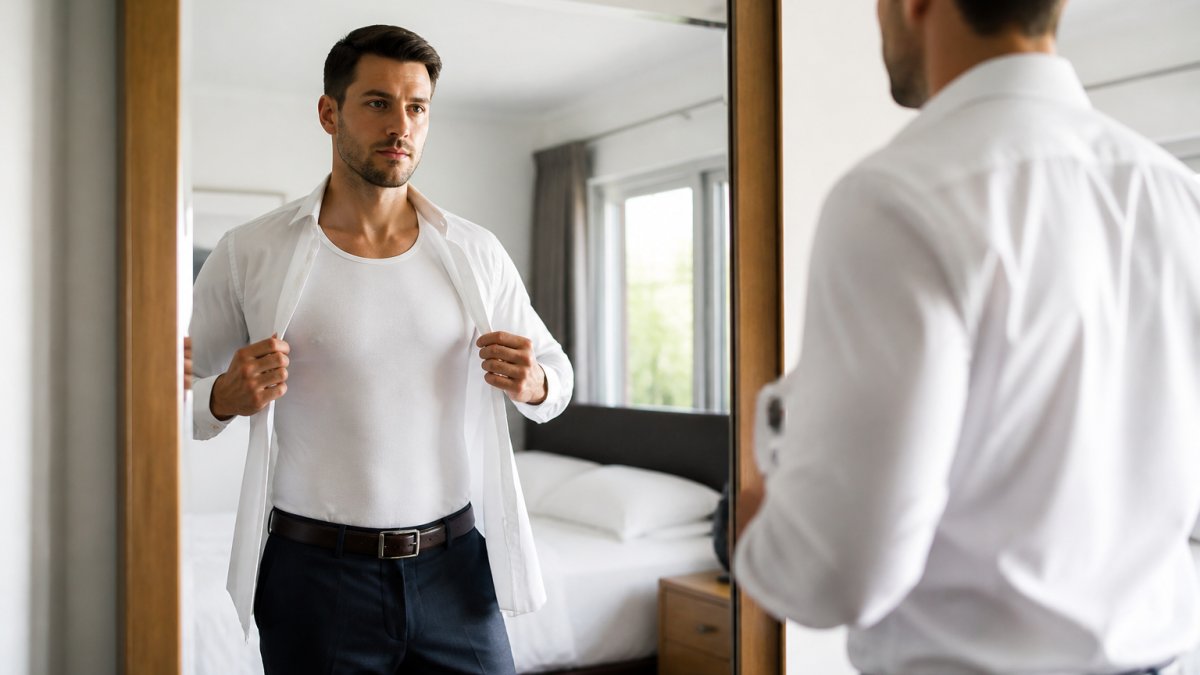
Before you order, check four things:
- The return policy. You cannot test fit through a screen.
- The fabric weight. Thin fabric shows wet marks faster.
- The underarm construction. A single layer rarely holds.
- The neckline depth. It decides what stays hidden.
What Actually Decides Whether a Sweat-Proof Shirt Works
Layering decides it. A sweat-proof undershirt works by absorbing and trapping moisture in a barrier layer before it reaches your outer garment. Fabric alone cannot do this; the construction has to.
That is why our undershirts run a triple-layer underarm shield. The shield sits where sweat output is highest, so the barrier is thickest exactly where you need it.
The Best Fabrics for Hyperhidrosis (and Why Cotton Alone Falls Short)
Cotton absorbs sweat well but holds it against the skin, which is why a plain cotton undershirt eventually soaks through. For hyperhidrosis, you want absorption plus a barrier plus stretch, and you also want a fabric that will not irritate skin that is already damp for hours at a time.
Here is how the main options compare:
| Fabric | Sweat Absorption | Dries Quickly | Stretch | Skin Feel When Wet |
|---|---|---|---|---|
| Cotton alone | High | No | Low | Heavy, clingy, stays damp |
| Synthetic wicking | Low | Yes | High | Cool at first, clammy once saturated |
| Bamboo blend | Medium | Yes | Medium | Soft, but can pill with friction |
| Cotton-spandex with barrier | High | Moderate | High | Dry against skin because moisture is trapped away |
Synthetic fibres move moisture but feel clammy once saturated. A cotton-spandex blend with a built-in barrier gives you absorption and flexibility at once, and keeps the wet layer away from your skin rather than against it.
The Better Health Channel guidance on excessive sweating notes that hyperhidrosis affects daily life well beyond comfort, which is why garment choice matters as much as antiperspirant.
Why Skin Sensitivity Changes the Buying Decision
Most fabric guides stop at wicking speed. That misses a large group of buyers: people whose skin reacts to constant moisture, friction, and residue from antiperspirant.
A few practical points that matter more than marketing claims:
- Seams and tags cause most irritation, not the fabric itself. Flatlock seams and tagless neck labels reduce the rubbing that turns damp skin raw.
- Antiperspirant residue plus synthetic fabric is a common irritant combination. If you apply antiperspirant at night and wear a synthetic base layer all day, the residue stays in contact with skin longer. A cotton-rich inner face buffers that.
- "Hypoallergenic" is not a regulated term in clothing. It is a marketing word. What you can check is fibre content, dye type, and whether the brand publishes any skin-contact testing. If a brand does not say, ask before you buy.
- Dyes matter for some people. Dark, heavily dyed garments can transfer dye onto damp skin. If you react easily, start with white or undyed options and test one shirt before committing to a pack.
- Wash before first wear. Residual finishing agents from manufacturing are a common cause of first-wear itching, and a single warm wash removes most of them.
A common pattern among people managing hyperhidrosis is that they blame their antiperspirant for irritation when the undershirt is the bigger factor. If you have already switched antiperspirants without relief, change the base layer next.
What to Look For on a Product Page
When you buy online, you cannot feel the fabric first. Use the listing to filter:
- Fibre percentages, not just fibre names. "Cotton blend" can mean anything from 60% to 95% cotton.
- Underarm construction. A described barrier, panel, or shield is a real design feature. "Moisture wicking" alone is a fibre property, not a construction.
- Seam type. Flatlock or bonded seams are less likely to chafe than standard overlocked seams.
- Care instructions. If a garment needs special washing, that is a signal about how delicate the finish is.
- Return window. Skin sensitivity is personal. You cannot predict a reaction from a spec sheet, so buy from somewhere you can return to.
How to Stop Sweat Marks on Shirts: Layering That Holds Up All Day
Stopping sweat marks comes down to what sits between your skin and your outer shirt. Get the layering order right and the marks never form.
The sequence that works:
- Antiperspirant applied to dry skin, at night
- A fitted sweat-proof undershirt as the base layer
- Your dress shirt or polo over the top
- A jacket or blazer last, if you wear one
Our undershirts are built for step two. The fitted construction tucks in flat so nothing shifts during the day.
A common mistake is wearing an undershirt that is too long. Anything past mid-hip bunches at the waistband and pulls loose when you sit down.
Matching the Base Layer to the Outer Shirt
Most guides stop at the order of layers.
Under a polo. Crew neck only.
Under an open-collar shirt with the top button undone. V-neck, cut deep enough to sit below the visible collar line.
Under a t-shirt worn as the outer layer. This is where the base layer stops being hidden.
Under a suit jacket. The jacket hides the neckline, so neck cut matters less. What matters is length and tuck.
"Pit Stopper" Neat™ Crew Neck Undershirt →
Professional Versus Casual: Two Different Jobs
The professional context rewards invisibility. Nothing should show: no neckline, no hem, no ridge through the outer shirt. That pushes you toward fitted cuts, neutral colours, and thin fabric with a real barrier.
The casual context rewards comfort and colour.
If you are building a rotation, buy for the context you spend most of your week in first. Most people over-buy for the office and under-buy for weekends, then end up wearing the same two shirts constantly.
Crew Neck vs V-Neck: Which Cut Stays Hidden
Crew neck stays hidden under polos and crew-neck shirts. V-neck stays hidden under open-collar dress shirts. Match the neckline to the outer shirt and nothing shows.
The rule is simple:
- Buttoned to the top: crew neck
- Top button open: V-neck
- Polo: crew neck
- Scoop or wide neckline: V-neck
Get it wrong and you get a visible line across your collarbone. Our V-neck undershirts are cut deep enough to disappear under an open collar without gaping.
Care Instructions for Sweat-Proof Clothing
Care instructions for sweat-proof clothing are simpler than most people expect. Wash warm, tumble dry low, and skip the fabric softener.
Fabric softener coats the fibers and reduces how well the barrier layer performs. Skip it entirely. Our shirts are machine washable and tumble dry without shrinking, which matters because a shrunken undershirt stops tucking in properly.
A few habits that extend the life of any sweat-proof garment:
- Wash after every wear
- Turn shirts inside out before washing
- Avoid bleach and high heat
- Do not iron the underarm panel
The Australian Competition and Consumer Commission guide to consumer guarantees is worth reading before any online clothing purchase, since it sets out what you are entitled to if an item does not perform as described.
Which Moisture Wicking Undershirt Fits Your Situation?
Match the shirt to how you actually wear it. There is no single best option, only the right one for your week.
For the office: the "Pit Stopper" Neat™ Crew Neck Undershirt at $55.00. Fitted, tucks flat, blocks sweat under a dress shirt.
For open-collar shirts: the "Pit Stopper" Neat™ V-Neck Undershirt at $55.00. Same barrier, invisible neckline.

For a full week: the "Pit Stopper 4-Pack" Neat™ Undershirt at $187.00, or the Work-to-Play Sweat Kit 4-Pack at $203.97 if you want colour options.
For a first order: the Neat™ Intro Pack at $87.00 gives you one white undershirt and one black tee, so you can test both roles.
For women's sizing and fit questions: our 4-pack range lists womens options alongside the mens cuts, so check the size guide before ordering.
One honest limitation: our white undershirts are designed as a layer, not a standalone.
Conclusion
Choosing the right undershirt is harder than it should be, and the wrong one costs you a shirt you liked. Sweat Proof Apparel builds every piece around a triple-layer underarm shield and Neat™ Fabric technology, with fitted construction that stays tucked and minimal shrinkage after washing. Start with the Intro Pack or a single Pit Stopper shirt and see the difference for yourself. Get started with Sweat Proof Apparel and stop thinking about your underarms by mid-morning.

Frequently Asked Questions
Do moisture wicking undershirts actually work?
They work, but they solve two different problems. Moisture-wicking fabric moves perspiration away from your skin so you stay drier and cooler. Sweat-proof undershirts go further and block moisture from passing through to your outer shirt. The Pit Stopper Neat™ range uses a 95% premium cotton and 5% spandex blend with an extra underarm shield, so sweat stays hidden inside the layer rather than surfacing on your dress shirt. If you mainly want comfort, wicking is enough. If you want no visible wet marks, you need the blocking layer too.
What is the best fabric for sweat-proof undershirts?
For hyperhidrosis, look for a blend rather than a single fibre. Pure cotton absorbs sweat but holds it against your skin and dries slowly. Synthetic fabrics wick fast but can cling and trap odour. A cotton-spandex blend, like the 95% premium cotton and 5% spandex used across the Neat™ range, combines moisture absorption with stretch and shape retention.
How do I choose the right size for an undershirt?
Measure your chest at its fullest point and match it to the brand's size chart rather than guessing from your usual t-shirt size. Sweat-proof undershirts need a fitted construction to sit close against the body, because a loose layer lets moisture travel around the fabric instead of through it. If you are between sizes, size down for blocking performance and up if you want more room through the body. The Neat™ shirts are cut snug on the arms with room around the torso, so they tuck without bulking under a dress shirt.
Can moisture wicking shirts prevent sweat marks on dress shirts?
They reduce them, but wicking alone does not stop marks appearing. Wicking moves sweat off your skin and spreads it through the fabric, which speeds evaporation but can still leave a damp patch on the layer above. To stop marks reaching your dress shirt, wear a sweat-blocking undershirt as the layer closest to your skin. The triple-layer underarm protection in the Pit Stopper Neat™ shirts is built specifically to stop moisture passing through, and the fitted cut keeps it tucked neatly under button-downs and polos.
How should I care for my moisture-wicking apparel?
Wash in cold water on a gentle cycle and avoid fabric softener, which coats the fibres and reduces how well the fabric moves moisture. Skip the dryer on high heat; a low tumble dry is fine and the Neat™ shirts are designed to tumble dry without shrinking. Turn the shirts inside out before washing to protect the underarm shield, and air dry them when you can. Following these care instructions for sweat-proof clothing keeps the fabric density and sweat-barrier performance intact wash after wash.